
 EN
EN



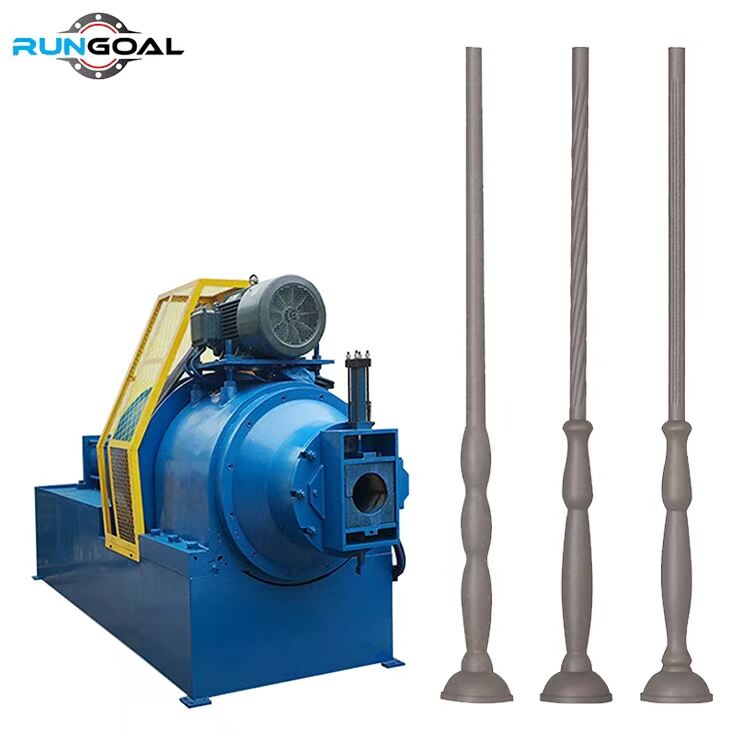
How Swaging Machine Enables Precision Cold Forming of Metal Tubes
Radial Compression Mechanics: How Oscillating Dies Achieve Controlled Diameter Reduction
Swaging machines achieve precise diameter reduction through radial compression—applying focused, room-temperature pressure via oscillating dies that rhythmically hammer the tube surface. This cold forming process displaces material inward without heating, preserving metallurgical integrity while delivering micron-level dimensional control. For aerospace hydraulic lines, this enables tolerances as tight as ±0.025mm. The dies’ synchronized motion ensures uniform axial deformation, eliminating wrinkling or buckling common in hot-forming methods. Unlike stretch-based techniques, radial compression maintains consistent wall thickness and achieves up to 50% diameter reduction in a single pass—per ASM International’s 2023 Cold Forming Guidelines.
Cold Swaging Benefits: Superior Grain Flow, Surface Integrity, and Tight Tolerances
Cold swaging delivers three distinct metallurgical advantages over thermal processes. First, compressive strain aligns metal grains parallel to the tube surface—boosting fatigue resistance by 30–40% in medical implant components. Second, the absence of heat prevents scale formation and decarburization, sustaining Ra 0.4µm surface finishes critical for leak-proof fluid systems. Third, work hardening during deformation increases yield strength by 15–25%, all while holding dimensional tolerances within ±0.05mm—essential for fuel injection rails where even minor deviations cause pressure loss. This synergy of enhanced material performance and precision makes cold swaging foundational for mission-critical applications.
Swaging Machine Configurations: Matching Technology to Tube Geometry and Industry Needs
Optimal swaging results depend on selecting the right configuration for tube geometry, length, and functional requirements. Two primary technologies dominate high-precision cold forming:
Rotary Swaging Machines for High-Speed Tapering and End Reduction
Rotary swagers use high-frequency oscillating dies (exceeding 1,500 strokes/minute) to radially compress tubing ends with exceptional speed and repeatability. They deliver precise tapering and end reductions up to 50%, maintaining circularity within ±0.002 inches. Key strengths include:
- Efficiency: Up to 500+ parts/hour in automated production
- Material fidelity: Cold forming avoids heat-induced grain distortion, preserving tensile strength
- Scalability: Processes tubes from 0.1mm micro-tubes to 6-inch industrial pipes
This configuration is ideal for automotive fuel lines and hydraulic fittings requiring consistent, high-volume end-forming.
Long-Die Swagers for Uniform Cross-Sectional Control in Critical Applications
Long-die swagers apply steady, distributed pressure along the full tube length—eliminating localized stress concentrations and ensuring homogenous deformation. This yields:
- Dimensional consistency: Wall thickness variation under 0.5% across lengths up to 24 inches
- Surface quality: Ra <0.4µm finish—achievable without secondary polishing
- Structural reliability: Improved fatigue life in pressure-critical components
These machines are essential for aerospace hydraulic systems and nuclear instrumentation tubing, where zero-defect performance is non-negotiable.
| Configuration | Best For | Dimensional Tolerance | Production Speed |
|---|---|---|---|
| Rotary Swaging | End reductions & tapers | ±0.002 inches | 500+ units/hour |
| Long-Die Swaging | Full-length compression | ±0.0005 inches | 150 units/hour |
Critical Industry Applications Driving Swaging Machine Adoption
Aerospace: Flare-Free Fitting Integration and Pressure-Integrity Tube End Sealing
In aerospace, swaging machines enable flare-free, cold-formed tube ends for fuel, hydraulic, and pneumatic systems—ensuring pressure integrity without compromising structural strength. By replacing traditional flaring, swaging eliminates stress-concentrating notches and potential leak paths, directly supporting compliance with FAA AC 20-107B and EASA CS-25 standards. The process maintains uniform wall thickness and surface finish, enhancing durability under rapid pressure cycling and extreme thermal gradients. As a result, it supports lightweight airframe designs, reduces maintenance intervals, and strengthens airworthiness assurance in safety-critical zones like engines and landing gear.
Medical Devices: Micro-Tube Swaging for Catheter Shafts and Miniaturized Sensor Housings
Medical device manufacturers rely on swaging for ultra-precise micro-tube forming—especially in catheter shafts and sensor housings used in diagnostics, ablation, and implantable monitoring. Cold swaging achieves sub-10µm concentricity and burr-free transitions, minimizing tissue trauma and infection risk. In catheters, it preserves controlled flexibility and kink resistance while enabling smooth navigation through tortuous vasculature. For sensor housings, it delivers hermetic seals that protect electronics from biofluid exposure—supporting FDA Class III device requirements and ISO 13485-compliant manufacturing. This capability accelerates innovation in minimally invasive therapies and real-time physiological monitoring.
Swaging Machine vs. Alternative Forming Processes: Why It Delivers Unmatched Control
Compared to hot forging, machining, or hydroforming, swaging stands apart through its ability to combine near-net-shape efficiency with micron-level accuracy and superior material properties. It avoids heat-induced degradation—such as oxidation, scaling, or grain coarsening—while enhancing grain flow alignment and structural integrity by up to 30%. Where machining removes material (generating 20–40% scrap), swaging conserves raw stock and eliminates secondary finishing steps—reducing total cycle time by ~40% and delivering surface finishes below 8 Ra µin (0.2 µm). Crucially, oscillating die technology achieves dimensional control within ±0.001 inches—consistently surpassing the repeatability of alternatives in applications ranging from aerospace fittings to 0.2mm-diameter neurovascular catheters. This convergence of material conservation, work-hardening benefits, and zero-defect repeatability makes swaging the benchmark for high-value precision cold forming.
Table of Contents
- How Swaging Machine Enables Precision Cold Forming of Metal Tubes
- Swaging Machine Configurations: Matching Technology to Tube Geometry and Industry Needs
- Critical Industry Applications Driving Swaging Machine Adoption
- Swaging Machine vs. Alternative Forming Processes: Why It Delivers Unmatched Control